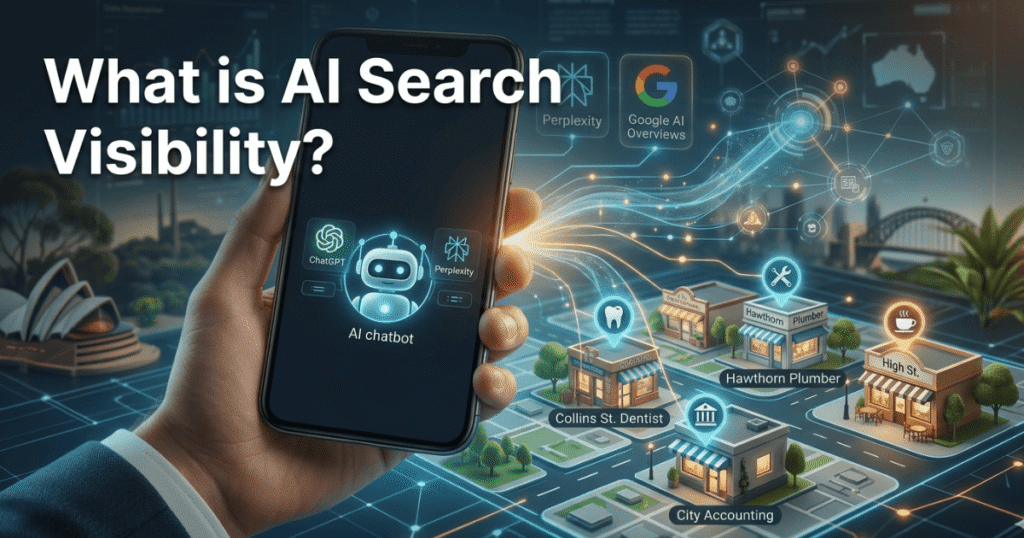
Quick answer: AI search visibility means getting your business named inside the answers that ChatGPT, Perplexity, Google AI Overviews and Gemini give to customer questions. It’s similar to traditional SEO but with different ranking signals – and right now it’s quietly deciding who gets the next phone call in roughly 30-40% of all online searches.
Last week a plumber in Hawthorn rang us, properly fed up.
He’s been on page one of Google for “emergency plumber Hawthorn” for three years. His website’s fine. His reviews are good. But his calls had dropped 40% since January.
We ran a thirty-second check. Asked ChatGPT: “Who’s the best emergency plumber in Hawthorn?” It named three businesses. He wasn’t one of them. Asked Perplexity – same three businesses, slightly different order. Asked Google’s AI Overview – same story.
His Google ranking was perfect. He just wasn’t appearing in the place where his customers were actually asking.
This is happening across Australia right now to trades, dentists, cafés, lawyers, accountants – businesses that did everything right under the old SEO rules. The rules have changed. Most people, including most marketing agencies, haven’t caught up.
This guide explains what changed, what AI search visibility actually means, why your business probably isn’t visible yet, and what to do about it. In plain English. No jargon.
What changed in 2026 (and the numbers that matter)
ChatGPT now has roughly 80% of the AI chatbot market and serves around 800 million weekly active users. Perplexity processes about 780 million queries every month. Google’s AI Overviews – those AI-generated summaries that appear above the regular search results – now show up on 30 to 40% of all searches.
Here’s the kicker: when somebody clicks through from an AI search to a website, they convert at radically higher rates than traditional Google search. ChatGPT-referred visitors convert at around 15.9%. Perplexity visitors convert at 10.5%. Compare that to organic Google clicks, which convert at about 1.76%.
In plain numbers: an AI search visitor is roughly 9 times more likely to become a customer than a traditional Google search visitor.
So even though AI search is smaller than Google right now, the visitors it sends are warm, ready, and high-intent. They’ve already asked an AI for a recommendation. They’re not browsing – they’re choosing.
The Australian businesses that get cited inside AI answers are quietly winning the high-value end of the market. The ones that don’t are watching their phone go quiet and blaming the economy.
How AI search actually works (the 30-second version)
When somebody types “best dentist near me” into Google, you get a list of links. You click one. You decide.
When somebody asks ChatGPT or Perplexity the same question, the AI does something different:
- It searches the web for relevant pages – usually through Bing’s index for ChatGPT, or its own crawl for Perplexity
- It reads the content of the top results
- It synthesises an answer that pulls from multiple sources
- It cites which businesses it’s mentioning
The customer doesn’t see ten options. They see one or two recommendations. If you’re not one of them, you don’t exist for that searcher.
The mechanics behind this matter for one practical reason: the rules for getting cited are different from the rules for ranking. Traditional SEO is about climbing a list. AI search is about being the answer.
Why traditional SEO alone isn’t enough anymore
Old-school SEO checklist: keywords, backlinks, page speed, mobile-friendly. That gets you onto Google’s first page.
It doesn’t get you inside ChatGPT’s answer.
AI engines look at things old SEO didn’t measure:
- Content extractability – can the AI pull out a clean, self-contained 40-word answer from your page? Walls of marketing speak get skipped.
- Factual density – does your content include verifiable statistics, specific numbers, dates, locations? AI prefers content it can fact-check.
- Entity authority – is your business mentioned across Reddit, Wikipedia, industry publications, directories? AI uses these as trust signals.
- Citation worthiness– – would another credible site link to this content?
- Freshness – Perplexity especially rewards recent updates. A 2019 article gets passed over for a 2026 one.
A site can rank #1 on Google and still be invisible in AI search. That’s the situation our Hawthorn plumber was in. Strong traditional SEO, zero AI search infrastructure.
The 5 things that actually determine AI visibility
After auditing 200+ Australian businesses across trades, healthcare, hospitality and professional services, the same five issues come up over and over.
1. Your website is missing structured data (schema markup)
Schema is code that tells AI engines exactly what your business does, where you operate, what services you offer, what hours you keep. Without it, AI has to guess from your messy navigation and inconsistent text.
Around 78% of the Australian local business sites we audit are missing critical schema. Adding the right schema markup is often the single biggest visibility win – and it can be done in an afternoon by anyone who knows what they’re doing.
2. You’re not in Bing’s index
ChatGPT pulls citations from Bing’s web index. Not Google’s. If you haven’t submitted your site to Bing Webmaster Tools, you’re invisible to ChatGPT searches – and Copilot, and partially Perplexity too.
This single setup step takes five minutes and is probably the most common omission we see.
3. Your Google Business Profile isn’t optimised
For local searches, your Google Business Profile is the single biggest factor in whether AI assistants (and Google’s own AI Overviews) recommend you. We’re talking primary category selection, secondary categories, photos, hours, services list, and steady review velocity.
In Australia, 78% of mobile local searches lead to an offline purchase within 24 hours. The businesses that capture those searches are the ones who took GBP seriously six months ago. Top three Map Pack positions capture 60-70% of local clicks.
4. Your content reads like marketing copy, not answers
AI engines extract content that directly answers questions. They skip vague marketing language.
Look at your service pages right now. Does each one open with a clean, factual sentence that explains exactly what the service is? Or does it open with something like “We are passionate about delivering excellence to our valued clients”?
If it’s the second one, AI extractors will pass it over and quote your competitor instead.
5. You have no third-party brand mentions
AI assistants build a picture of your business by reading what other websites say about you – directories, blog mentions, Reddit threads, news articles, review platforms. The more diverse, credible mentions you have, the more “real” you look to AI.
If your only online presence is your own website and a Facebook page, you read as low-authority. Even one good guest post or one strong industry directory listing helps.
The 5-minute self-check you can do today
Want to see exactly where your business stands? Try this right now:
- Open ChatGPT (free version is fine) and ask: “Who are the best [your service] businesses in [your suburb]?”
- Note whether your business appears in the answer. If yes – great, you’ve got some visibility. If no – you’re invisible.
- Open Perplexity and ask the same question.
- Open Google and search the same query – look at the AI Overview at the top (if shown). Are you in it?
- Visit your website and right-click → View Page Source. Search the page for the word “schema”. If you see no results, you have no structured data.
That five-minute check tells you 80% of what you need to know about your current AI search position.
What you can do this week
If the check above showed gaps, here’s what to prioritise (in order):
This week:
- Submit your site to Bing Webmaster Tools –
bing.com/webmasters. Free. Five minutes. - Claim and complete your Google Business Profile if you haven’t already. The primary category choice and first six photos do most of the work.
- Add basic schema markup to your homepage and service pages. If you’re on WordPress, plugins like Rank Math or Yoast SEO handle this in a few clicks.
Next month:
- Publish two pages of genuinely useful content – answers to questions your customers actually ask, with specific facts, numbers, and clear structure.
- Get five new Google reviews from past clients. Send them the direct review link by text. Make it stupid-easy.
- Get listed on three Australian directories – True Local, Yellow Pages AU, Hotfrog. Same name, address, phone format on everyone.
Next quarter:
- One piece of new content per week, every week. No exceptions. Each one written to answer a real question with extractable, factual content.
- Aim for one guest post or industry mention per month.
- Track which queries are starting to mention your business. Adjust based on what’s working.
It’s not magic. It’s discipline applied to the right tasks, in the right order, for long enough.
When to get help
This is the work we do at IndexAI every day. Some businesses can handle it in-house if they have the time and someone who genuinely enjoys this stuff. Most don’t.
If you want a clear picture of where your business currently stands – without committing to anything – our free 1-page AI Readiness Audit does exactly that. We run the checks above (plus about fifteen more), then send you a one-page PDF with the top three fixes ranked by impact. Delivered in 24 hours. No card, no login, no follow-up sales pitch.
It’s not a sales tool dressed up as a free thing. We genuinely use it to show what we’d do before asking anyone to pay us. About 60% of the businesses we audit don’t end up needing us they take the report and fix things themselves. That’s fine by us.
Frequently asked questions
Will AI search replace Google?
Probably not entirely, but it doesn’t need to. Google itself now puts AI Overviews on 30-40% of search results, which means even on Google, the rules are shifting. The smart move is being visible across both – traditional search rankings and AI citations.
Is AI search visibility just rebranded SEO?
No, though they overlap. Traditional SEO optimises for ranking on a list of links. AI search visibility optimises for being cited inside a generated answer. The technical signals partly overlap (good content, schema, page speed) but the end goal is different. You need both.
How long does it take to see results?
Most businesses see initial AI citations starting within 60–90 days of doing the work properly. Google AI Overview appearances follow a similar timeline. Sustained visibility takes 6 months to build and longer to defend. Anyone promising results in 2 weeks is either misleading you or about to use tactics that’ll get you penalised.
Do I need to be on TikTok and Instagram for this?
For most local Australian service businesses – no. AI search citations come primarily from your website, Google Business Profile, industry directories, Wikipedia, Reddit, and news mentions. Social media helps reputation but isn’t a direct ranking factor for AI citations.
My competitor seems to be everywhere in AI search. How?
Almost always one of these: they started six months earlier, they have steady review velocity (10+ per month), they publish content consistently, they’re cited on industry directories you’re not on, or they’ve had a strong PR mention pulled into AI training data. None of these are unfixable. They just take time.
Is this just a fad?
Search behaviour is shifting permanently. ChatGPT, Perplexity, Google AI Overviews, Gemini, Claude – these are now where significant portions of customer research happens. Apple is building AI search into Safari. Microsoft has Copilot baked into Windows. The shift is structural, not a fad. The window to build visibility early is now.
Where this leaves you
You’ve got two choices.
You can wait and watch, hoping AI search doesn’t matter. Some businesses will be right – if your customers are all 70+ years old and find you only through word-of-mouth, you’re fine.
But for most Australian local businesses, the calls coming in via AI search are quietly going to your competitors. The plumber in Hawthorn lost 40% of his business in five months while his Google ranking stayed identical. By the time the trend is obvious, the businesses that started early will have a year’s head start.
The fix is straightforward. The work is consistent. The cost of waiting is much higher than the cost of starting.
If you’d like us to show you exactly where you stand, our free 1-page AI Readiness Audit takes 24 hours to deliver. No card, no pitch, no obligation. Just answers.
IndexAI is Australia’s AI search visibility partner – helping local tradies, dental and medical clinics, hospitality, retail and professional services get found inside ChatGPT, Perplexity, Google AI Overviews and Gemini. Based across Australia, remote-first by design.